If dating in real life feels harder than it should, it’s probably because it is. All culture migrated online, including one night stands. So, instead of spiraling into endless whys, let’s check out the best next thing: one night stand apps that help you find real, casual partners.
Beyond app functionalities, matching mechanics, and niche communities, we’ll also cover how both the apps and you as a user can avoid wasting time on bots and fake accounts. So, if you’re looking for something real but still chill, stick with us.
Best Hookup Apps to Meet Real People
Tinder
Overview
One of the most widely used dating apps in the world, known for swipe-based matching and casual dating potential. It frequently appears on “most used” lists globally.
User Base And Activity
One of the biggest user bases, with a culture highly focused on casual dating and hookup culture. While swipping, you’ll come across spammy or misleading profiles, but Tinder has a couple of system in place to mitigate and protect its genuine users against scams and bots.
Tinder has millions of real users, and many people genuinely meet partners through it. While it isn’t exclusively a hookup app, it’s still widely associated with casual dating.
Unfortunately, while swiping, you’ll likely come across a significant number of low-effort, spammy, misleading, or outright fake profilesincluding bots and users with AI-generated or stolen photos.
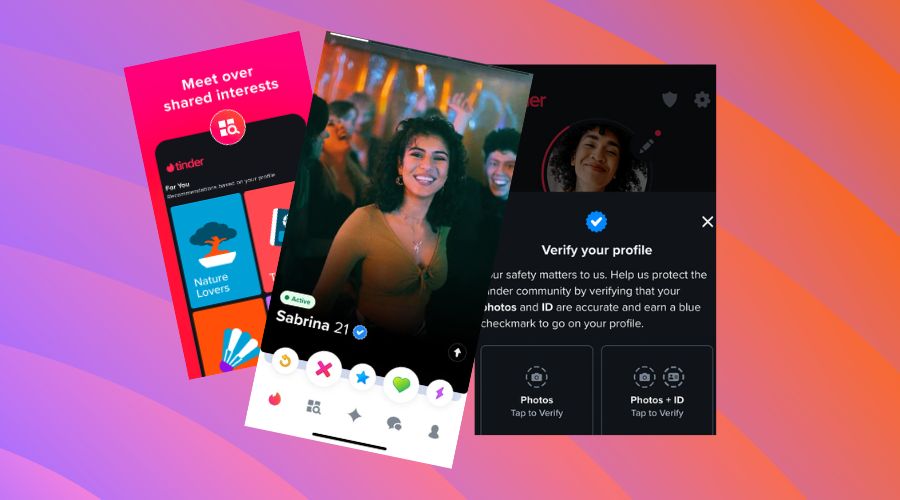
To increase your chances of matching with real people, look for Photo Verified badges or Face Check verification (a feature currently available in California, India, and a few other regions). You can also report suspicious or inappropriate accounts.
AI-generated photos aren’t always automatically blocked unless Tinder’s verification systems catch them, and these images can look surprisingly realistic. Not all users complete verification, so fake profiles and bots can still slip through the cracks, especially in less regulated regions.
Ultimately, verification features are a strong deterrent but not foolproof. It’s best to combine Tinder’s in-app tools with your own judgment, such as asking for a video call, checking social media, and meeting in public places, to stay safe.
Matching & Discovery Mechanics
The location-based discovery makes Tinder a great hookup app. You set a close range + other preferences and the chances to match with likeminded users are pretty high. Matching mechanics work on mutual swipes. Some paid features allow you to see who liked your profiles before you swipe, boost your profile or move you closer to the front of someone’s stack.
On Tinder, discovery is mostly location-based. You set your age range, gender preference, and distance (usually 5–20 miles for something casual), and the app shows you one profile at a time. You swipe right if you’re interested, left if you’re not. Tinder prioritizes active users and tends to show profiles that get a lot of right swipes more often. A match only happens if you both swipe right it’s mutual. Until then, no one knows you liked them. Once matched, either person can message, and things usually move as fast as the vibe allows.
Beyond the basic mutual match, Tinder pushes a few premium features that change how discovery works.
With Tinder Gold or Platinum, you can see who already liked you before you swipe so instead of guessing, you can match instantly. That skips the waiting game and speeds things up.
Boost puts your profile in front of more people for about 30 minutes, increasing visibility during peak hours.
Super Like signals stronger interest and moves you closer to the front of someone’s stack.
There’s no messaging without a match (unless it’s a Super Like with a short note on Platinum), so mutual interest is still the gatekeeper.
Communication Features
On Tinder, communication only unlocks after a mutual match. Once that happens, either person can start the chat, there’s no built-in rule about who messages first.
The chat is text-based, but you can also send GIFs, emojis, and “Likes” on specific messages. You can share photos inside the chat (within app rules), and there’s a video call feature if you both enable it.
You’ll see read receipts only if you’ve purchased them.
If things go nowhere, either person can unmatch at any time — which immediately deletes the conversation for both sides.
Privacy & Data Handling
Tinder does a good job at keeping your data private from other users. However, it does collect personal data to properly run the app, including your location, swipe behavior, and device used.
Tinder collects and processes a lot of personal data to run the app, including precise location, swipe behavior, messages, device info, and usage patterns for matching, personalization, moderation, and ads. Other users only see basic profile info: first name, age, photos, bio, and approximate distance in miles. Messages are stored on Tinder’s servers, and verification features use biometric analysis. Users can block contacts, report suspicious profiles, request their data, or delete their account, though some information may be retained for legal reasons.
User Experience & Interface
On Tinder, the user experience is designed to be fast, simple, and swipe-focused. The main screen shows one profile at a time with large photos and minimal text, making decisions quick and intuitive.
Swiping right or left is the core interaction, supported by clear icons for Super Likes, Boosts, and other actions. Navigation is straightforward, with tabs for your matches, messages, and discovery settings. Premium features like Boosts or seeing who liked you are integrated seamlessly, and in-app prompts guide new users. Overall, the UI is visually clean, mobile-optimized, and geared toward instant engagement.I.
Down
Overview
Users pick casual hookups or dating intent. The app is designed for quick, spontaneous connections. Most users are young adults.
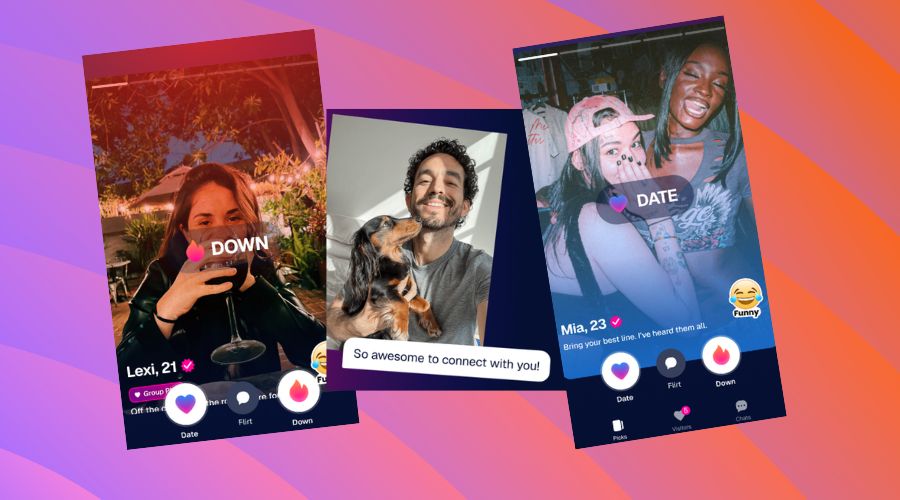
When you create a profile, you choose “GET DOWN” for hookups or “GET DATE” for more serious dating. This intention is displayed to other users immediately, helping filter people who aren’t compatible. The app is popular with young adults and Gen Z singles, particularly in urban areas, and encourages fast decision-making and spontaneous connections.
User Base and Activity
Active user base mostly in cities. Most are looking for casual connections. Real-life meetups happen frequently.
Down has an active user base of 15–17 million people, concentrated in larger cities where singles are nearby. Most users are seeking casual hookups or adventurous experiences, but some are open to dating. Matches often lead to in-person meetings, and activity peaks during evenings and weekends. The app is less active in smaller towns, so users in rural areas may need to expand their distance settings to find matches. Overall, the community skews younger and open-minded, creating a fast-paced, casual environment.
Matching & Discovery Mechanics
Swipe down for hookups, up for dating, left to pass. Matches happen only on mutual interest. Filters and premium features help refine discovery.
Down shows profiles based on your location, gender preference, and intent. You swipe down for casual hookups, up for dating, or left to skip. A match only happens if both people swipe in a compatible direction. The app also offers Nearby Picks, which highlights users close to your location, and additional filters for preferences such as age, popularity, or adventurous interests. Premium features like VIP increase visibility, allow more daily swipes, and prioritize your profile in other users’ feeds, helping boost the chance of connecting quickly.
Communication Features
Messaging opens only after a match. You can use text, stickers, and icebreakers. All chat stays in-app and is secure.
After a mutual match, users can chat inside the app. Messaging is text-based, but Down adds interactive tools like icebreaker prompts, stickers, and photo challenges to make conversations more engaging. Chats are fully contained in the app ,no phone numbers or external messaging apps are required.
Notifications alert you to new messages, and conversations can be un-matched at any time, which deletes the chat for both users. These features keep interactions controlled, secure, and playful.
Privacy & Data Handling
Down collects location, usage, and profile data. Only basic info is shared with matches. Sensitive data is stored securely.
Down collects personal data including your signup info, profile content, location, device info, and messaging behavior. Only your first name, photos, and basic profile info are shared with matches. Exact GPS coordinates are not visible to other users, though the app processes precise location behind the scenes to power discovery features. S
Sensitive information, like photos and payment details, is handled securely. Users can block or report profiles, request their data, or delete their account, though some information may be retained for legal reasons.
The app does not verify age or perform background checks, so users should follow standard safety practices.
User Experience & Interface
Swipe-based UI with intentions front and center. Tabs organize matches, messages, and filters. Paid features increase visibility but don’t guarantee matches.
Down’s interface is simple, swipe-based, and mobile-optimized. Your intentions (“GET DOWN” or “GET DATE”) are highlighted prominently to guide discovery. Profiles show photos, a short bio, and optional stickers or highlights to express personality. Tabs organize matches, messages, visitors, and filters, and the app supports paid features like VIP subscriptions,
Boosts, and extra swipes. These features increase visibility and improve the chance of matching but don’t guarantee results. Overall, the app emphasizes fast, casual decision-making and playful interaction, appealing to users who want spontaneous connections.
Pure
Overview
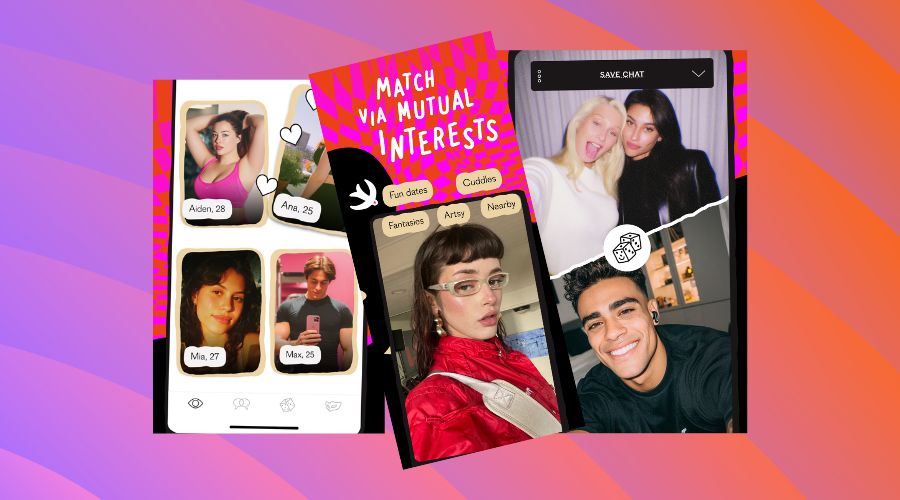
Pure encourages users to stay anonymous and minimal. Your session typically lasts a short period (often around 24 hours) and then disappears, along with any chat history, which enhances privacy and keeps things fresh. You’re usually represented by one photo and a short description of what you’re open to; many users stay anonymous beyond that. This makes the app feel more like a live casual meeting board than a traditional dating platform.
User Base and Activity
Pure attracts people looking for hookups and casual interactions. Activity varies by location, and many users report fake or inactive profiles.
The user base is mixed, with many people seeking casual hookups, sexting, or spontaneous meetups. Some areas with many active users show decent engagement, but in quieter regions the activity can be low. Many real users complain about fake profiles, bots, or scripted interactions — especially patterns where new users get lots of likes/messages before paying, then see engagement drop sharply, which reviewers interpret as synthetic activity or poor real engagement.
User reviews also mention unexplained bans and problems with customer support, and some people describe the app experience as poor or scam‑like due to paywalls and lack of real matches.
Matching & Discovery Mechanics
Pure shows you nearby users’ short ads. If someone likes your ad or you like theirs, you can chat. Profiles and sessions expire quickly.
Pure doesn’t use the typical swipe stack. Instead, you post a short ad or browse a feed of “sessions” from nearby people within your selected distance. When another user expresses interest, a match is created and chat opens. Both ads and chats often auto‑expire after about 24 hours to maintain anonymity and encourage quick decisions.
Communication Features
Chat is available only after a mutual match is made. Messages usually disappear with the session. Everything stays inside the app.
Once two users are connected based on mutual interest, you can message inside the app. Pure’s design deletes session content and messages after the time limit, so chats generally don’t stay long. The focus is on quick, direct communication that leads to real‑life meetups or ending the connection. There’s no phone or SMS integration — all chat happens in‑app.
Privacy & Data Handling
Pure deletes profiles and chats after a short time, and minimal information is shared. Some data is still collected to operate the service.
Pure emphasizes privacy by automatically removing user sessions and messages after a short period. Because it doesn’t store long‑term profiles, there’s less long‑term data exposure. However, personal data such as your photo, location, usage patterns, and device info is still collected to run the platform and enable discovery. Safety tools like photo verification and age verification have been introduced in some regions as part of broader safety efforts, but not every market has these features yet.
User Experience & Interface
The UI is minimalist and focused on short ads instead of swiping. Sessions disappear quickly, and interactions are brief.
Pure’s interface is simple and minimalistic, centered around posting and browsing short ads. You upload one photo and a brief description of what you want, then wait for responses. When someone engages with your ad, you can start a timed chat session. Because content disappears quickly, the experience feels fast and ephemeral, which some users like and others find frustrating.
Feeld
Overview
You create a detailed profile with gender, sexuality, and preference options. Couples can link profiles. Paid upgrades add privacy and visibility tools.
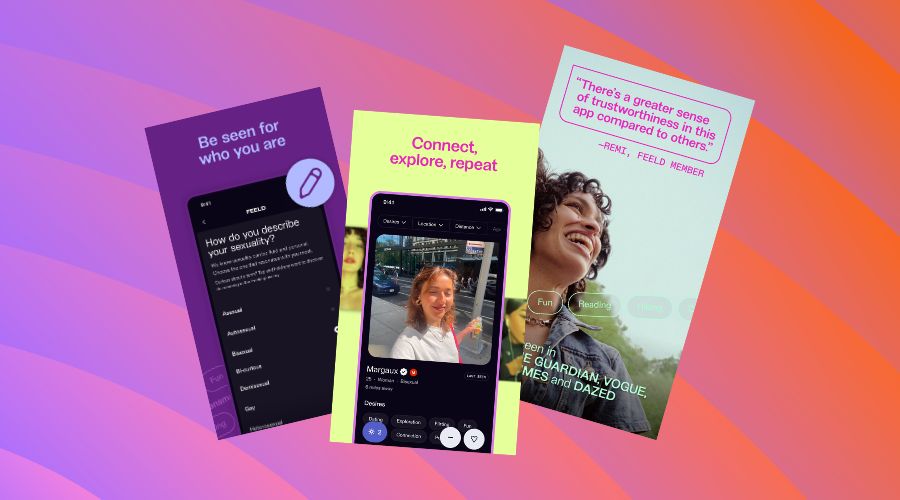
On Feeld you set up a profile that lets you choose from many gender identities and sexual orientations, and you can also define how you want to be seen, whether by singles, couples, both, or specific combinations. Couples can link profiles so all partners appear together, making group exploration easier. The app has free and paid tiers; premium (Majestic) unlocks features like Incognito Mode, advanced filters, and visibility boosts.
User Base and Activity
Feeld attracts a niche, open‑minded crowd interested in alternative relationships, kink, or exploration. Activity is higher in bigger cities. Profiles are real but unverified users still exist.
Feeld’s user base is smaller and more niche than mainstream apps like Tinder, with many users identifying as queer, poly, kinky, or simply open to non‑traditional dynamics. Most activity is concentrated in large, progressive urban areas; rural and smaller markets can feel sparse, with repeated profiles and slower response rates. Community emphasis on honesty and consent tends to deter large bot farms, but unverified or inactive accounts do appear, and there aren’t sweeping background checks beyond optional photo verification.
User feedback also highlights issues like imbalanced gender ratios and people misrepresenting themselves or looking for casual hookups without understanding community norms. Some users report repeated profiles or minimal replies over time if preferences don’t align with available members.
Matching & Discovery Mechanics
Feeld uses a swipe‑and‑like discovery system based on preferences and location. Mutual likes create a Connection, and premium tools can boost visibility or bypass waiting.
Feeld shows you profiles one at a time in a “Discover” feed influenced by your distance, age range, gender and sexuality filters, and relationship preferences. You swipe right (or “like”) to express interest or left to pass. A mutual like forms a “Connection,” unlocking chat. Premium users can send Pings to alert someone to your interest and use Uplift to appear ahead of other profiles in their area.
The app doesn’t have a strict algorithm that shuffles you into an endless queue; instead it’s more organic and depends on local activity and how closely preferences match. Users can revisit skipped profiles with some subscription features, and you can also explore “Locations” to look farther away.
Communication Features
After a Connection, you can chat in‑app with text, photos, group messages, and voice messages. Couples can automatically create 3‑way chats.
Once you match with someone, Feeld opens a chat where you can send text messages, share photos (within guidelines), or use voice messaging. A unique aspect is group chat, when a couple matches an individual, Feeld automatically sets up a three‑person chat so no one has to awkwardly add a partner manually. Group chats can also form among other linked profiles. The app encourages open communication and respect, and messages stay in‑app rather than moving to SMS.
Privacy & Data Handling
Feeld offers optional privacy features like Incognito and private photos. Verified badges help trust, and the company enforces reporting and moderation policies.
Feeld lets you control how visible you are with features like Incognito Mode (premium) so you only appear to people you’ve already liked. You can mark photos as private, which only matches see, and enable automatic blurring or nudity detection to manage sensitive content. The app supports reporting of abuse, harassment, or inappropriate behavior, and states that fake or misleading profiles aren’t allowed.
Feeld also offers photo verification, where users take a selfie to match their profile photos, helping reduce catfishing. However, verification isn’t mandatory, so unverified accounts still exist. While there have been past security concerns, the company says it addresses vulnerabilities and improves safety features.
User Experience & Interface
The UI is clean, minimalist, and less cluttered than some mainstream apps. Navigation is intuitive, with a focus on openness and consent.
Feeld’s interface is simple and contemporary, with swiping and tapping as core interactions. Navigation places discovery, messages, and preferences within easy reach, and profile setup includes plenty of customization for identities and desires. The app is designed to feel less transactional and more expressive, encouraging thoughtful bios and clear communication about interests and boundaries. Some users report occasional bugs or confusing behavior with likes and discovery, but many appreciate the clean design and inclusive features.
Grindr
Overview
Grindr uses your phone’s location to show people nearby in real time. You don’t swipe, you browse a grid and tap to chat. Some features are free; many extras are premium.
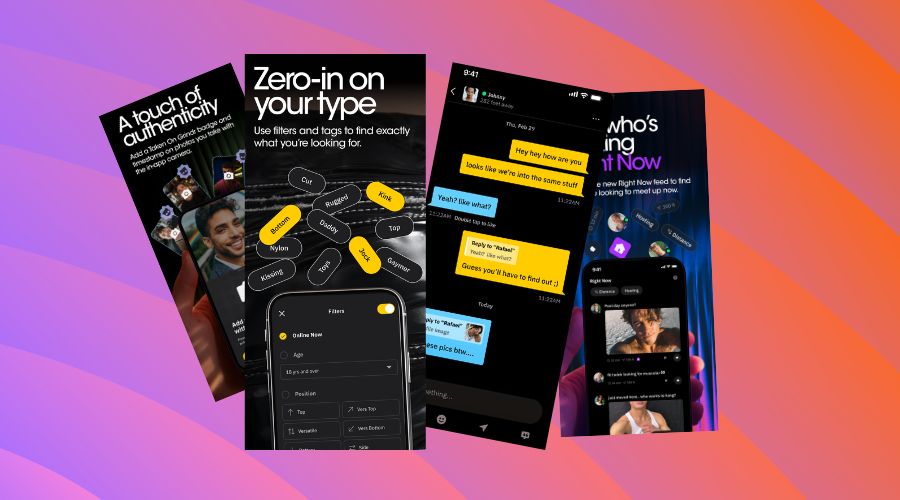
When you open Grindr, you see a grid of users near you, typically ordered from closest to farthest (in feet or miles). You can view profiles, send messages, and share photos right away. There’s no mandatory mutual match, messaging opens directly if someone has chosen to allow it in their settings. Free accounts can do the basics, but many filters, visibility tools, and advanced features (like “who viewed me” or read receipts) are behind subscriptions.
User Base and Activity
Grindr has a large, active user base around the world, especially in urban areas. Fake profiles or bot‑like behavior can appear, and moderation uses AI and manual review.
Grindr is widely used globally and reported to have millions of active users, especially in major cities where proximity‑based discovery works best. Because the app is free to join and doesn’t require deep profiles, some profiles can be inactive or low‑effort, and users occasionally report bots, spam accounts, or fake profiles. Grindr uses automated tools and human moderators to flag spam, harmful behavior, and rule violations, but fake or low‑quality profiles still show up and users should report them when they appear.
Matching & Discovery Mechanics
There’s no swipe matching. You see a grid of people nearby and can message any open profile. New AI and live feed features help discovery.
Grindr shows people near you based on your GPS location, usually within a radius you can set. Instead of swiping, you browse a grid or feed of nearby users sorted by distance, tap a profile to view details, and message right away if that person’s settings allow it. Premium additions and AI‑based tools may soon help recommend profiles you’d like or surface matches you might miss. The app also has newer features like a live “Right Now” feed that shows moment‑based posts from users in your area.
Communication Features
You can chat directly with anyone who allows messages. Chats support text, photos, and location sharing within the app. No mutual match step is required.
Once you tap a profile, you can start a chat if the user hasn’t restricted messages. Grindr supports text chat, photo sharing, and location sharing inside the app. There’s no separate mutual match requirement ,many hookups start with a direct message immediately after browsing. Messaging tools like read receipts, advanced filters, and “who viewed me” are often part of premium subscriptions.
Privacy & Data Handling
Grindr collects a lot of personal data — including precise location and profile content, and shares some with third parties and service providers. Privacy protections exist but have been criticized.
Grindr collects your profile information, location data, usage details, and other personal info you choose to share. This data is used to show you nearby users and power recommendations, and it can be shared with third‑party partners for services like fraud prevention, analytics, ads, and customer support. While Grindr offers tools to control data sharing and a Safety & Privacy Center to manage it, past investigations have shown that location and other sensitive data were previously shared more widely than many users expected. Users can adjust privacy settings, opt out of certain features, and request copies of their data, but sensitive info like precise location and profile content is routinely processed to run the service.
User Experience & Interface
Grindr’s UI is a grid of nearby users, easy to scan and tap. It’s less swipe‑focused and more about real‑time browsing and chatting.
The interface presents nearby users in a grid of photos, typically sorted by distance. It’s designed for fast browsing, you scroll, tap profiles of interest, and message directly. Tabs organize your conversations, discovery feed, and settings. The mobile UI is straightforward but has become increasingly monetized, with some features moved behind subscriptions and aggressive ads reported by users. Many people value the immediacy of the interface, while others feel key tools have been restricted for paying members
Plenty of Fish (POF)
Overview
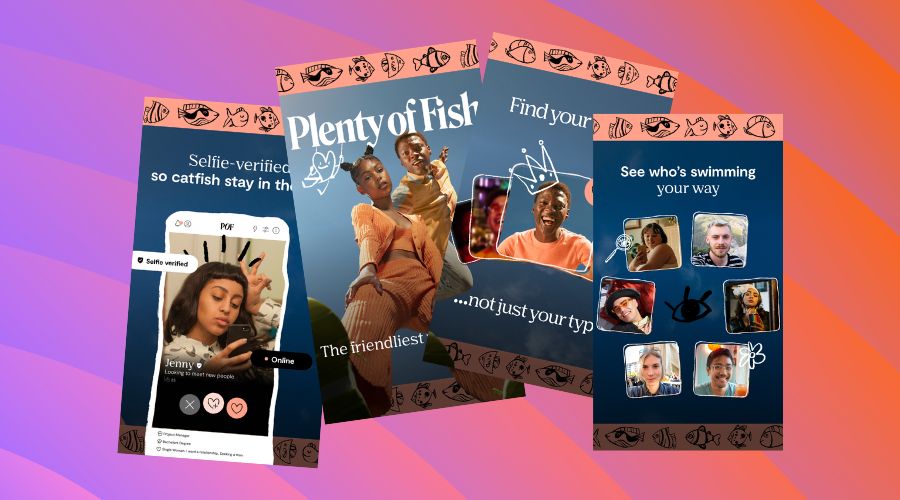
On POF you create a profile with photos, personal info, preferences, lifestyle details, and relationship goals. The app encourages detailed self‑presentation so matches can be more meaningful, and you can also take optional quizzes like the “Chemistry Test” to get compatibility suggestions. While basic messaging, search, and browsing are free, paid subscriptions (Premium and Premium Plus) give you perks like ad removal, read receipts, seeing who viewed your profile, advanced filters, and profile highlighting.
User Base and Activity
POF has millions of users globally with varied intentions, casual dates, friendships, or serious relationships. Fake or inactive profiles do show up, and user reports suggest inconsistent engagement in some areas.
POF claims a very large user base (estimated in the hundreds of millions), with diverse age groups and dating goals. Many people use it for serious matchmaking, friendships, or casual dating. Because the free messaging is a big draw, there are frequent reports of fake or low‑effort profiles, spam, and bot‑like accounts, common on free platforms. Users often recommend reporting suspicious profiles and being cautious with early interactions.
Matching & Discovery Mechanics
You can browse profiles and indicate interest with the “Meet Me” feature like swipe matching, and POF also uses algorithms to suggest compatible people. Search filters refine results.
POF combines traditional search with a gamified discovery tool called Meet Me that works similarly to swipe apps — you indicate interest or pass on a profile and mutual interest can lead to conversations. The platform also uses algorithms that analyze preferences, behavior, and quiz results to recommend potential matches. Users can apply search filters like age, location, interests, and relationship intent; premium tiers unlock even more specific filtering.
Communication Features
Unlimited messaging is free, which sets POF apart. Chats support text and photos, and some paid perks improve messaging visibility.
One of POF’s biggest draws is that messaging is free, you can send and receive messages without a paid subscription, which is rare among dating apps. Conversations happen through in‑app messaging where you can share text and photos; voice notes or video features vary by region. Premium members can see read receipts, message highlights, and who’s viewed their profile, making it easier to follow up.
Privacy & Data Handling
POF collects a wide range of personal and sensitive data to power matching and targeting, and it may share data across Match Group services and with partners. Users can control some data practices.
Plenty of Fish collects profile information (including sensitive details like orientation and beliefs if you choose to share them), location, activity patterns, device identifiers, and interactions to power its matching features and deliver personalized ads. It uses automated decision‑making and profiling to recommend matches and help moderate the platform. The app may share data with other Match Group properties and third‑party partners unless you opt out in privacy settings. You can request data deletion or limit certain data uses, but location and other core data are integral to the service.
User Experience & Interface
The UI is a mix of traditional dating site detail and app browsing. You get profile browsing, search filters, and features like Meet Me and quizzes. Some users find the experience cluttered or ad‑heavy.
POF’s interface blends classic dating site depth (lots of fields and questions) with modern app features like swipe‑style discovery and dynamic recommendations. You navigate between browsing matches, search filters, messaging, and tools like quizzes or community forums. Many users appreciate the free messaging and detailed profiles, but some report a cluttered experience with lots of ads, occasional technical glitches, and mismatches between preferences and shown profiles.
How to avoid online dating scams
All apps we mentioned do have pretty strong anti-scam policies and employ various technology to mitigate it. Still, online dating, be it on a dedicated app or through social media, exposes people to sophisticated scammers that learn to move beyond restrictions.
That said, there are some things that are always true and pretty universal ways to stay safe and avoid scams:
- Protect Your Personal Info: Don’t share your phone number, home address, or financial details too early. Keep sensitive info private until you fully trust the person.
- Verify the Person Yourself: Ask for a video call, check social media, or confirm details before meeting in real life.
- Keep First Meetings Public: Always meet in a public place and let a friend know where you’re going. Safety starts with your actions.
- Set Boundaries: Be clear about what you’re comfortable with and don’t let anyone push you past that.
These steps put control in your hands and help you navigate online hookups safely, without relying solely on app protections.